The Sacred Scrapheap: Confessions of Creatives Who Won't Bin Their Knackered Kit
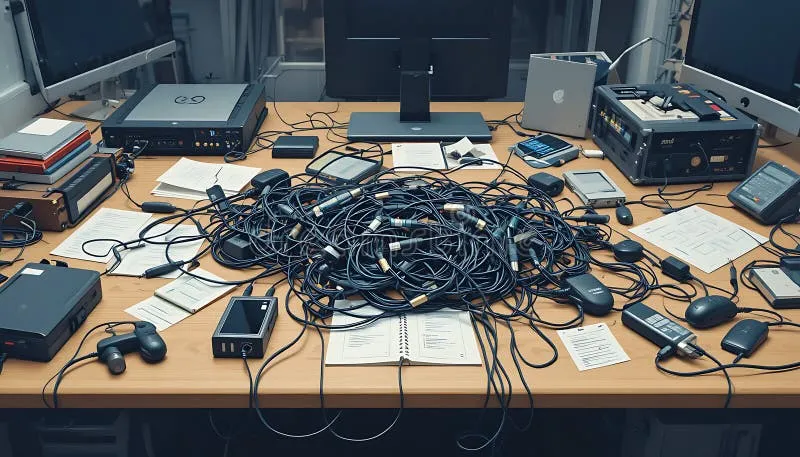
Photo: cluttered creative studio desk old worn graphics tablet and taped cables, via thumbs.dreamstime.com
There's a shelf in a Sheffield animation studio that nobody is allowed to touch. On it sits a Wacom Intuos 3 from roughly 2008, its surface worn smooth as a pebble, its cable patched with electrical tape in three places. It hasn't been connected to anything in six years. It will not be thrown away.
"It did my first paid job," says the studio's founder, who asked we use only her first name, Priya. "Binning it feels like binning my CV."
If you work in a creative studio anywhere in the UK — from a Soho post house to a garden shed in Fife — you already know exactly what this is. The relic. The knackered bit of kit that outlived its usefulness years ago but has somehow achieved protected status, like a listed building nobody can afford to maintain.
The Museum of Almost-Broken Things
Ask around and the patterns emerge fast. There's the flickering BenQ monitor in a Cardiff motion graphics studio that "only misbehaves on Tuesdays" (it does not only misbehave on Tuesdays). There's the Focusrite audio interface in a Manchester podcast setup that crackles unless you hold the gain knob at precisely 3.2, a fact known to exactly one person. There's the Mac Pro tower in Glasgow being used, currently, as a doorstop.
"It's not sentiment, it's strategy," insists Tom, a freelance retoucher in Bristol, entirely unconvincingly, before admitting he still opens files on a laptop with a hinge held together by a binder clip. "Clients see it and think I'm scrappy. Scrappy means cheaper rates. That's my story and I'm keeping it."
The rationalisations are a genre unto themselves:
- "It still works." (It does not still work.)
- "Replacement parts are on back order." (They have been since 2021.)
- "New kit has teething problems." (So does the old kit. Constantly. Audibly.)
- "It's got character." (It's got a dead pixel the size of a full stop that you've named.)
Sunk Cost, Sentiment, and the Tax Return
Underneath the jokes there's something more honest about freelance life in Britain right now. Kit is expensive, the pound doesn't stretch like it did, and HMRC's replacement rules don't cover emotional attachment. When a £1,200 tablet needs replacing, the £1,200 doesn't exist — it's already allocated to the accountant, the rent on a studio share, or the frankly criminal price of a train ticket to a client meeting in London.
There's also the superstition factor, which no one admits to and everyone practises. The mixer that "can't be moved or the render fails." The SSD that must be ejected in a specific order. The camera body with 400,000 shutter actuations that "knows my settings." Creative work is fragile enough that people will take a lucky charm wherever they can find one, even if the lucky charm is a 2013 MacBook Air that sounds like a hairdryer.
And then there's identity. A battered tablet with a worn-out centre is a receipt for a decade of work. It's proof you were there, grinding, before the studio had a proper chair. In an industry that runs on portfolios and noise, the knackered kit is a private record no algorithm can verify.
When It Finally Goes
Every relic eventually dies properly, and the mourning is real. When a Leeds illustrator's ancient Cintiq finally gave up mid-commission, she reports "a full five minutes of silence, then a cup of tea, then eBay." The replacement arrived in two days. It's better in every measurable way. She still keeps the dead one, boxed, under the desk. Obviously.
So here's the Broken Pixel official position: keep the relic if you must, but buy the backup. Insurance exists. Depreciation exists. And if your monitor only misbehaves on Tuesdays, that's not character — that's a deadline waiting to happen.
Now if you'll excuse us, our keyboard's spacebar only works if you press it at the left edge, and we've grown quite fond of it.