Next to the Boiler, Beating the Cloud: Meet Britain's Airing Cupboard Sysadmins
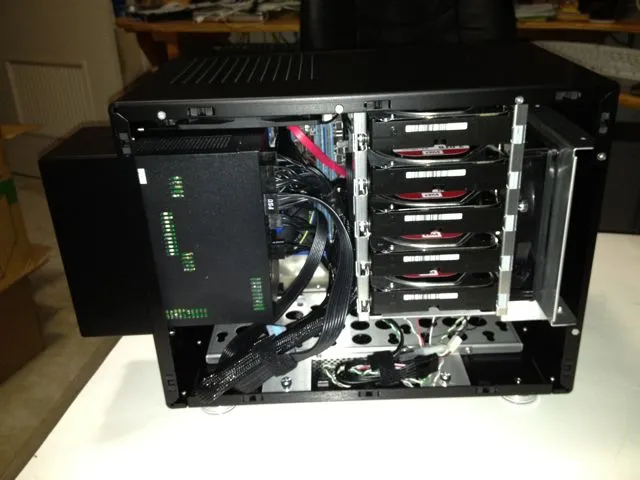
Photo: home server NAS setup in cupboard with hard drives and cables, via www.cassandra.org
There is a particular hum that comes from a cupboard in a semi-detached house in Stockport. It is not the boiler, though the boiler is two feet away. It is not the tumble dryer, though the tumble dryer shares the shelf. It is a second-hand Intel NUC, four years past its warranty, running the entire digital archive of a branding studio — and its owner couldn't be happier.
"People think I'm mad," says the owner, who asked us not to use his name because, in his words, "my mum still thinks I work in IT and I'd like that to continue." "But I was paying £11.99 a month for storage, another tenner for the apps, and every year the price crept up like a parking fine. Now I pay the electric company. That's it."
The Great De-Subscription
Self-hosting — the practice of running your own storage, backup and app servers on hardware you own — used to be the exclusive hobby of bearded men on forums with avatars of penguins. No longer. A quiet movement of UK creatives is discovering that a £60 Raspberry Pi, a couple of second-hand drives and a free weekend can replace a surprisingly large chunk of the monthly software bill.
The appeal is obvious. Subscription fatigue is real, and it's biting hardest among freelancers whose income arrives in lumps. A designer in Leeds told us she cancelled four subscriptions after realising she was spending more per year on file sync than on her professional indemnity insurance. "I don't miss the cloud," she says. "I miss not worrying about the cloud. That's the point."
The kit itself is gloriously unglamorous. Nextcloud on a NUC. A Synology bought refurb from an eBay seller in Slough. Hard drives shucked from external enclosures, labelled in biro, sitting on a shelf that also holds a box of spare cables every British household is contractually obliged to own. One photographer in Cardiff keeps her entire RAW archive on a shelf above the towels, on the reasonable grounds that the airing cupboard is "warm, dry and nobody goes in there except me and the cat."
The Real Maths
We did some back-of-fag-packet arithmetic. A typical freelancer paying for cloud storage, a photo library app and a backup service might shell out £250–£400 a year. A self-hosted setup — hardware, drives, a one-off NAS box — costs roughly the same upfront, then pennies to run. Over five years, the self-hoster is comfortably ahead, provided nothing catastrophic happens.
That provision is doing a lot of heavy lifting, of course.
"The 2am problem is real," admits one editor in Glasgow who runs a home server for video proxies. "The cloud doesn't wake you up when a drive dies. Your server does. Because you get the alert, and then it's you, in a dressing gown, at half two, swapping a disk while the kettle boils." He pauses. "Twice a year, maybe. I'll take that over a price hike."
The self-hosters we spoke to are unanimous on one thing: backups. The 3-2-1 rule — three copies, two media types, one off-site — is repeated with the fervour of a religious text. The off-site copy is usually a drive at a relative's house, or an encrypted cloud backup as a belt-and-braces fallback. Even the loudest anti-subscription voices keep one. "I'm not daft," says our Stockport sysadmin. "I'm cheap, not brave."
Downtime, Domesticity and the Boiling Point of a Modem
What nobody warns you about is that your server becomes part of the house's ecosystem. It must survive vacuum cleaner incidents, radiator bleeding, and the annual visit of a parent who asks why "the internet box" is making that noise. One self-hoster's setup went down for a full day because a partner unplugged it to charge a phone. The marriage survived. The UPS was purchased the next morning.
There's also the domestic comedy of it all. Home upload speeds in much of Britain remain a punchline, and self-hosting from home means your files are only as reachable as your router. One rural illustrator in the Welsh borders says accessing her own files from a client's office requires "a VPN, a prayer, and Openreach doing its best." She's fine with it. "The alternative was £9.99 a month forever. I've seen forever. It's long."
Broken Pixel Verdict
Is self-hosting for everyone? Absolutely not. If your relationship with technology is strictly transactional — it works, or someone else fixes it — stay subscribed and enjoy your weekend. But if you've ever enjoyed labelling a drive, if the idea of owning your archive outright gives you a small warm feeling that no monthly invoice ever has, the airing cupboard is calling.
The hum from Stockport, for what it's worth, is very quiet. Quieter than the boiler. Cheaper than the subscription. And entirely, stubbornly, his.