Desk Archaeology: What Your Monitor Dust Says About Your Career
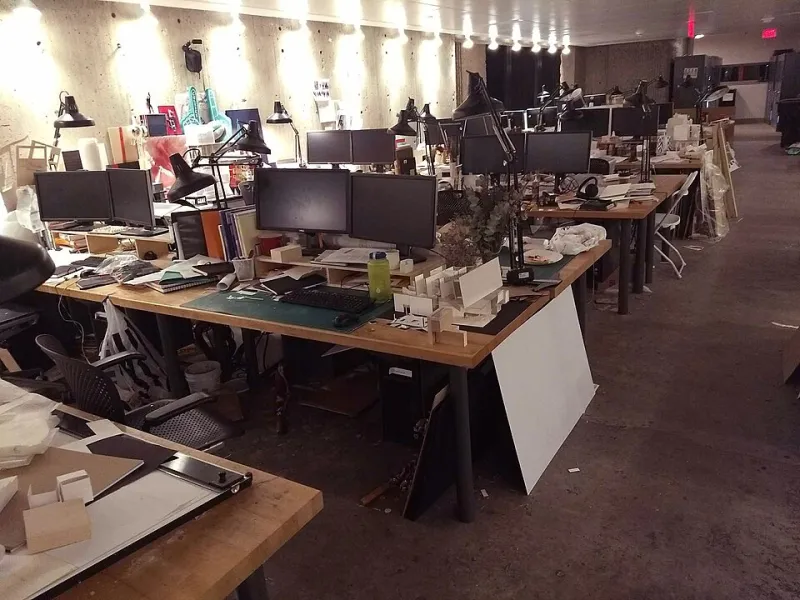
Photo: RukshanV, CC BY-SA 4.0, via Wikimedia Commons
Somewhere in Britain right now, a motion designer is sitting at a desk with two monitors, one of which displays nothing but Slack and a slowly accruing layer of dust. A graphic designer is staring at a Wacom tablet that has never once been unboxed. And in the corner of both desks sits a plant — bought in a fit of January optimism — that has witnessed more deadlines than a hospital waiting room.
We call this desk archaeology, and we're convinced it tells you more about a creative's career than any portfolio ever will. You can fake a case study. You cannot fake the fact that your second monitor has been used exclusively as a shelf for a tin of biscuits since 2022.
The Strata of the Setup
Every British creative desk has layers, and like a particularly disappointing trifle, you can date a person by what's on top.
The Student Layer: One laptop, propped on a stack of unread books to create "ergonomics." The laptop is a MacBook bought on a finance plan that outlived the degree. There is one mug. The mug is never washed so much as rotated.
The First Job Layer: A second monitor appears, bought with the first proper payslip. It is positioned at a defiant angle, as if to say I am a professional now. The Wacom is purchased around this time too, still in its shrink-wrap, because the buyer read that "real designers use tablets" and panicked.
The Freelance Leap Layer: Cable management happens. Genuinely — velcro ties, a cable tray, possibly a standing desk. This is the career equivalent of buying a suit. The plant arrives here. The plant is always named. The plant is always, eventually, dying.
The Established Layer: The desk is a mess again, but a confident mess. Three devices, none of them new. A graphics tablet that is actually used, covered in the worn patina of a thousand pen strokes. A printout of an invoice pinned to the wall as a motivational totem.
The Second Screen Is for Guilt
Here's the thing nobody says out loud: for a huge number of UK creatives, the second monitor isn't a productivity tool. It's a monument to who they thought they'd become.
You bought it because the YouTubers had one. You positioned it vertically because a designer you admire uses theirs vertically. And now it displays your email client at a resolution you can't read, next to a main screen doing 100% of the actual work.
It's not a monitor. It's a shrine. And the dust on top of it is measuring something no analytics dashboard can: the gap between ambition and Tuesday afternoon in a flat in Salford with the radiator on.
The Plant Barometer
We've developed a rough taxonomy of the studio plant, and honestly, HR could use it.
- Thriving monstera: Bills are being paid on time. Someone in this household is sleeping.
- Surviving succulent: Busy but coping. The succulent doesn't judge. That's why it was chosen.
- Crispy mystery plant, species unknown: Deadline mode. The plant has been watered with cold tea at least once.
- Dead plant, not yet removed: A creative in the bargaining stage. They've noticed. They've decided to notice later.
- Plastic plant: Full self-awareness achieved. This person has been through things.
Submit Your Desk for Judgment
Which brings us to the fun part. We want to see your setups — the good, the bad, and the shrink-wrapped. Send us a photo of your desk via the usual channels and our panel of deeply unqualified experts will assess your career stage, your psychological state, and your plant's chances, with the brutal honesty of a mate who's round for a brew.
We'll publish the best (worst?) ones in a future feature, names optional, dignity not guaranteed.
Because here at Broken Pixel, we believe the truth about British creativity isn't in the showreel. It's in the cable spaghetti, the guilt monitor, and the fern that's seen better deadlines. Show us yours. We've already shown you ours — the second screen is currently holding a Yorkie and a receipt from B&Q, and we're at peace with that.